Sunday, May 15, 2011

Phoenix Rises

When planning travel and destinations Chris and Jay try to stay near friends to visit, when possible.  Phoenix was one of those places.  In fact, three friends lived there and having plenty of time to share with all three is always a scheduling problem, especially when those friends most always have their own lives and that terrible, 4-letter word: WORK to deal with.  Thus it was with Matt & Sandy Hankerd.  Matt was Jay’s 20th and last cook on his charter boat in the Caribbean and spent more than a year together both in charter and cruising Honduras and Belize and many fun adventures too numerous to mention.  Matt now is an Assistant Manager of a very posh restaurant in Scottsdale so has a non-standard work-week.  As luck would have it he was off on Tuesday and Wednesday as Chris and Jay were arriving.  This good news was made even better by Matt wanting to show off his culinary skills by inviting the weary travelers to join them for dinners and fed them profusely for nearly the entire week they were there.  The only downside was that Sandy was ill so Chris and Jay didn’t have near enough time to enjoy her company. 

After Matt left the boat he attended the Culinary Institute in Scottsdale and though he never worked as a chef after that he loves to cook.  Words simply cannot describe the scrumptious delights he can conjure up.  Chris took notes and asked many questions while Matt created his gastronomical treats.  Even Jay was attentive as Matt revealed many secrets to preparing incredible food.  When Matt wasn’t cooking he played tour guide and showed them the local spots including the best place to watch landing F-16’s at Luke AFB and the best grocery stores and cheapest fuel.


An F-16 preparing to land at Luke AFB.


Although Jay’s back was somewhat improved by the Tucson traditional Chiropractor, there was no way he would be able to function normally without further professional help.  The priority during the Phoenix visit was to find an A.R.T. (Active Release Therapy) Chiropractor that could actually correct the problem and get Jay back to one hundred percent.  The frustration is that finding ART Chiro’s is difficult; there just aren’t many of them around.  Four were found close to the RV Park in the Phoenix area and with the price of diesel near $4.00 per gallon finding one that was geographically desirable was imperative.  The nearest one was on vacation but the next closest was available.  Jay called and spoke to the most helpful Doctor's Assistant, Melissa, whose smile was evident in her voice, and happlily scheduled a Thursday appointment.  Dr. Michael Jarembek (or Dr. J, of Phoenix Sports & Spinal Medicine www.phoenixssm.com, 602-212-1122) a young, strapping, good-natured guy who performed the most thorough skeletal examination Jay had ever had.  Dr. J then proceeded to adjust things Jay didn’t even know he had; much less knew could be adjusted.  When finished, Jay arose from the adjustment table as if a Phoenix being reborn and at least an inch taller.  After witnessing the nearly magical results Chris immediately made an appointment for herself and they decided to stay in Phoenix an extra two days to allow time for more adjustments from this man with the magic hands.  They even video-taped the next sessions so they would not make a mistake while doing the exercises and ART therapy Dr. J taught them to keep them in good shape for the summer of hiking that was scheduled.  Between Matt’s food and Dr. J you can bet Chris and Jay will return when their summer activities are terminated in Utah and Montana.

The RV Park in Phoenix was chosen partly for its location but mostly for its price.  It seems most RV parks in the area are set up for winter “snow-birds” with “frosty” prices to match and it turned out the park’s heated pool and hot-tub were perfect for jay to relax his tortured muscles as his back was healing itself.

 As Chris was tending her garden, which travels with us, a rather well-fed Road-Runner paid her a visit walking right up to her and looking around.  All was well as Chris got some photos of the bird until it flew up on the table with her herbs.  All Chris could envision was the bird eating her garden that has had to endure creatures of all descriptions at all locations doing just that.  Needless to say the Road-Runner was given a quick flying lesson as Chris chased it away with great enthusiasm.  A few days later, as Jay’s former Commanding Officer from Houston, Dave Ciancaglini, visited for dinner, the bird dropped by for another visit.  Dave informed Jay that the birds were carnivores and would probably not bother the plants.  As if on cue the bird flew up onto the table and walked through all the planter boxes investigating what was there but then, showing no interest in the vegetation, flew away looking for a more pleasing hand out.


The visiting Road Runner.


Rounding out the triad of friends to visit with was a day spent with Tom Luttrell and Val Cialkowski who operated the Charter Boat “Prego” in the Virgin Islands when Jay lived there.  They had become good friends over the years and Chris had met them several years ago when they were all in Colorado together.  Jay only learned they had moved to Phoenix while in Tucson so it was an added plus to see them while there.

While traveling the country Chris wants to visit galleries that may show her work and there is one in Scottsdale that she has had contact with so a meeting with them was advantageous.  It so happened that Matt’s restaurant was only a few blocks away and he wanted Chris and Jay to visit him there.  Now chain restaurants aren’t usually on the list of places for them to patronize but they were completely blown away by the décor and quality of food.  Grand Lux Café would rival any restaurant anywhere in the world and FORCED Chris and Jay to over-eat to the point they not only took doggie bags home but had to walk off dinner at a nearby mall before they could climb into Big Red for the journey back to the RV Park.


The Grand Lux Café, the restaurant where Matt works.


On Thursday, the 14th of April, the well-adjusted (chiropractically speaking) and stuffed (gastronomically speaking) travelers departed Phoenix heading to Sedona, AZ where the spring and summer of serious photo work was to begin.

Recovery in Tucson

The Davis-Monthan Air Force Base RV campground, in Tucson, did not take reservations and was a popular destination for the Snowbirds that wintered there.  In the cooler months campers may have to wait in the overflow area, where there are no hookups for water, electricity or sewage, for a week or more for a site to become available.  By mid-March, the winter residents were beginning to head home and within two days those awaiting a site were able to move in.   Jay’s back was in good enough shape to allow him to drive from Tombstone to Tucson and they arrived on Thursday, March 17th, pulled into the overflow area and waited their turn.

An ART (Active Release Technique) practitioner was located and an appointment was made for the following morning.  With Chris’s assistance, and taking miniscule baby steps, Jay hobbled into the office and waited his turn.  It was then that they discovered the ART practitioner was not a Chiropractor but a Physical Therapist.  The tiny, but mighty young lady worked him over but did not adjust his whacked out skeleton and he left, not only poorer but in just as much pain has he had arrived and efforts to secure an appointment with a local Chiropractor were futile.  Jay returned home went to bed and stayed there through the weekend.  Occasional forays to the “facilities” were accomplished by slithering on his stomach until his feet, then his knees, touched the floor and crawling on all fours until he reached the vanity counter.  With Chris’ assistance (which then caused strain on her back) he was able to push himself upright and, clinging to walls and door jams, shuffle into the bathroom and relieve himself.  Chris would have videotaped the painful but comical effort to share with their readers, but thought some might be offended by his lack of attire.

Saturday morning came and Chris trundled up to the campground office, selected a site and moved the RV out of overflow.  Jay felt so helpless lying in bed while Chris maneuvered Big Red and hooked up Sonny, raised the front and back stabilizing legs, secured the stairs and drove to their new digs.  Fortunately it was a pull-through site and, with a neighbor’s assistance to make sure she didn’t hit vehicles and utilities, within moments she was in position, connecting electric, water and sewer, bumping out the slides and setting up the household comforts inside.  

The weekend dragged as Chris searched the internet for treatments she could administer to her ailing spouse and attended to the nursing duties required to keep Jay fed, warm, cool, relieved, washed and entertained.  Fortunately a Saturday night dinner invitation from her cousins Helen Nazzaro and Janet, Corey afforded a welcome break.

Helen was Chris’ mother’s first cousin and Janet is Helen’s daughter and visiting with them was the primary reason for stopping in Tucson.  Janet has spent untold hours researching the Clark/Harmon genealogy for the last several decades and over Chris’ three week stay they shared generations of family photos (including tin types of relatives Chris had never heard of), military records, documents and letters.  Chris left a legal sized accordion folder stuffed full of family records for Janet to digest over the next six months, since her attention would be on traveling and photographing and not on family research.


Janet (left) and Helen (right) after our dinner at the Country Club.


Helen and Janet referred Jay to a Chiropractor they used and after a few treatments he was ambulatory and eager to re-engage in life, albeit at a slower pace than normal.  Janet chauffeured them to the Arizona-Sonora Desert Museum located over a mountain to the west of Tucson.  The term museum to describe the attraction was a bit of a stretch for Chris and Jay to accept as they associate the term with brick and mortar structures.  The museum is open desert covering 100 acres with broad paths winding throughout that take you past 1,200 kinds of plants and animal exhibits.  Tucked into the hillsides are enclosures containing more than 300 animal species including mountain lions, bobcats, prairie dogs and Gila monsters.  One of their favorite stops was the hummingbird house where dozens of the tiny birds zipped past their heads building nests and feeding their young. 


A view of the Desert Museum terrain with valley and mountains in the distance.


An exciting event they attended was a Raptor Free Flight Demonstration of a family of Harris’ Hawks.  That day the trainers released five birds and the audience learned that they live and hunt together as a family in groups of three to seven.  They soared above then swooped so close that Chris felt the wind from the beat of a wing as one flew through the crowd then perched atop a Saguaro cactus.


A trainer with one of the hawks.


Another outing was to the Mission San Xavier del Bac , an active church constructed in the late 1700s by Franciscan missionaries with money borrowed from a local rancher.  It is beautifully restored inside and out and was designated a National Historic Landmark in 1963.  The intricate carvings, paintings, frescoes and statues in the alter areas must have been designed to wow the Indians whom the missionaries were there to convert. 


A view from the back of the church of the ornately carved and painted altar
 and frescos on the ceiling.


Janet insisted that a visit to Tucson wasn’t complete without lunch at the Tohono Chul Park Tea Room – one of her favorite places.  Tohono Chul Park is recognized as one of the great botanical gardens of the world and is located on 37 acres in the northwestern section of Tucson.  It is home to a plethora of reptiles, birds, and every kind of desert plant known to the area.  The park is a popular location for weddings, art exhibits and talks of all types.  After an enjoyable lunch Jay bought a zebra succulent plant from the greenhouse to replace one that died months before and he returned home, literally, a happy camper.


Chris and Jay at the Tohono Chul Park.
Jay is holding his new Zebra succulent plant that he bought to replace one that died.


The travelers didn’t do half of what they’d planned during their stay since every other morning was obligated to chiropractic appointments but in a way it was relaxing and forced them to slow their pace and “smell the cactus flowers” that were just beginning to bloom.  A week-long stop in Phoenix was next on the itinerary and they knew that after that the main focus would be photographing for the rest of the summer beginning with Sedona, the Jewel of Arizona.


Some of the cactus that were blooming when they left Tucson.

Tuesday, April 5, 2011

Backwhacked in Tombstone

Tombstone, Arizona.  Oh, the images of the Old West those two words conjure up in the American psyche: The Earp brothers, O.K. Corral and the trials of a booming, silver mining town in the 1880s combine to create the legend of “The town too tough to die”.

The town was named by Edward Schieffelin, a scout for the soldiers at Fort Huachuca in the 1870s, who, in his free time, scoured the mountains of the southeast Arizona Territory seeking his fortune.  A soldier told him that the only stone he would find was his tombstone.  But Schieffelin was one of the lucky ones.  When he located the richest silver vein in the area, Tombstone was born.


Photo of Tombstone’s founder, Edward Schieffelin,
taken by famous western photographer, C. S. Fly.


Four blocks of the original town have been beautifully preserved and visitors can dine in Big Nose Kate’s Saloon, originally owned and named for Doc Holliday’s girlfriend, or the just as famous Crystal Palace.  Both boast massive, dark, 19th century bars original to the structures.  A variety of shops occupy the town’s buildings where one could walk in a city-slicker and walk out bedecked top to bottom in western garb from a wide-brimmed Stetson and ornately designed fist-sized silver belt buckle to sturdy, hand tooled leather boots.  Other stores sold jewelry of all styles but predominantly silver and turquoise creations.  You could don a dance hall dress or cowboy gear to have a vintage style portrait taken and cool down in the heat of the day with an ice cream cone.  The Tombstone Epitaph newspaper was founded in 1880 and continues to print a monthly edition making it the National Newspaper of the Old West.


Big Nose Kate’s Saloon.


The bar at the Crystal Palace Saloon.


A stagecoach, drawn by a pair of complacent horses, ambled through the streets while the western attired guide drawled on about the town’s history in a twangy country accent.

Chris and Jay opted to learn Tombstone’s history from the museum located at the old Tombstone Courthouse State Historic Park.   Displays explained the history of the Apache Indians in the Territory, successful and failed negotiations between them and the whites, the Earp brothers and the real story of the gunfight at the O.K. Corral, about assaying silver from the mines, the Chinese’s role in the populations, and the actual, untouched court room from its mining heyday.  Chris marveled at the rich brown tone fabric and tiny waistline of a schoolmarm’s dress. 


The gallows adjacent to the Courthouse.


Actors depicting the Earp brothers and their friend, Doc Holliday, roamed the streets posing for pictures with visitors and interacting with their nemeses the Clantons and the McLaurys, cowboys that were suspected of robbing stagecoaches and poaching cattle.  As the street conflicts between the actors increased an ever larger crowd gathered around them and they carried the act through the town and into the O.K. Corral where the legendary confrontation was played out on a ground-level, outdoor stage just a few paces from the actual gunfight site.


The faceoff at the O.K. Corral.


During the previous week, Jay’s back had gradually become more painful to the point of rendering him bedridden the first two days of their stay.  He rallied the afternoon of the third day just in time to see the gunfight and he and Chris got front row seats for the show as it would have been impossible for him to climb the bleacher seats that lined one whole wall of the enclosure. 

The show lasted about half an hour and told the story, mainly from the Clanton’s and McLaury’s side, of what led up to the thirty second gunfight, on the afternoon of October 26, 1881, that left three of the cowboys dead and wounded Doc Holliday and Virgil and Morgan Earp.  Debate, as to exactly what happened and why, continues to this day and the event has been played out in numerous novels and movies since it was first publicized in Stuart Lake’s biography of Wyatt Earp in 1931.

Due to Jay’s back pain, they never got to Boothill Graveyard, Tombstone’s cemetery.  They were told it is a must-see destination and that the epitaphs on many of the headstones are witty and memorable so they decided it was an excuse to make a return trip next year. 


Not wanting Jay’s back problems to escalate, Chris did the lion’s share of the preparations Jay would normally do to move the RV but by the end of the two hour drive to Tucson on Thursday, March 17th he could hardly walk and to bed he went until they could see a chiropractor the following Monday.


Tuesday, March 15, 2011

A Bridge Too Low

If you have been following Chris and Jay’s travels from the beginning, the title of this entry might sound ominous but, Fear Not and Read On!

They like to stay off the interstate highways when moving to their next destination and found a route from Alamogordo to Gila (pronounced heela) Hot Springs using scenic secondary roads through the mountains.  Chris had begun using their travel time to compose the blog and had her head buried in her work when Jay saw a sign stating: “Low bridge 22 miles ahead”.  He pulled the rig over and stopped in front of a Bureau of Land Management sign.  Figuring they would have record of the bridges on their land, Chris located a phone number for the local office and called.  Louis tried to be helpful but the task was beyond his pay grade.  The bridge was 4” lower than Sonny.  With the sun’s progress west, and considering their past trials, Chris and Jay decided to back track and be safer than sorrier.  No new learning experiences for them that day.

They had wanted to stay at Gila Hot Springs because it was only a few miles from the Gila Cliff Dwellings National Monument, built in the 13th century by the ancient Mogollon Indian Tribe.  The detour to stay in Silver City turned their drive to the cliffs into a 44 mile, 2 hour trip along steep, narrow roads riddled with hairpin turns that climbed and descended the 8,000 foot peaks.  The views were spectacular as the pine laden mountains formed layers of ridges tapering to narrow valleys stretching far to the horizon.   The travelers were glad they had left Sonny in Silver City as the volume of diesel fuel required to haul the tonnage up and down the slopes would have set them back a pricy night out!


The gorgeous mountains of the Gila National Forest.


After a stop at the Visitor Center, Chris donned her camera vest and she and Jay got quite a workout hiking the narrow, unpaved trail to the dwellings.  The gentle ascent along the canyon stream was a cinch.  It was the steps and steep switchbacks that caused the heart rate to soar.  Fortunately there were some “viewing areas” along the way which provided a good excuse to stop and catch their breath under the auspice of taking photographs. 


Cave number 2 had one of the largest openings.


Margaret and her husband, John, were volunteering three months of the year at the Park and she eagerly led Chris and Jay through several caves commenting how she enjoyed talking with “interesting people”.  She explained how a room with bench seating cut into the rock and three-sided, rock fire pits in the floor, were thought to be used as kivas for tribal ceremonies, where the shaman supposedly lived, why some openings in the walls may have been created by vandals or falling rocks and that the tribe only lived in the caves for about 30 years – most likely leaving due to a decline in water supply.


This two-story room may have been used for curing meats and tanning hides .


A “T” shaped doorway leading to one of the living areas.


She appreciated Chris’ desire to photograph the unique setting and told the story of a group she had guided sometime earlier.  A young woman wearing short-heeled shoes was in the group and when her boyfriend asked if she was going to take any pictures she replied that there wasn’t anything there to photograph!!!  She truly dwelled in a different universe.


Chris and Jay at the Cliff Dwellings.


The name Silver City conjured up a hodgepodge of images from the Old West and an afternoon was devoted to seeing how many of them were real.  Billy The Kid had lived in the town during his teens and the city had grown around the silver and copper mines that made some wealthy and sapped the life from others.


An 1870s style cabin that was built for the movie “The Missing”
and now sits on the Visitor Center property.


Man’s impact on the natural surroundings dealt an immense financial blow to the town in the late 1800s.  The massive timbering of the trees in the mountains and overgrazing of the lower grasslands left nothing to absorb the sporadic, torrential rains that plagued the area.  One day the town flooded and the turbulent waters swept away the entire Main Street, and soil down to the bedrock 60 feet below, taking all structures but one brick home with it.  The resulting gorge came to be known as The Big Ditch and thereafter commercial buildings and homes were made of brick and block and located at a higher level where they remain today and contain shops, artist studios, hotels and restaurants. 


A section of the gorge that was created during the flood.
The town created this Big Ditch Riverwalk Park to make use of the area.


Chris and Jay had arrived in mid-afternoon and were able to get a walking tour guide of the city, from the museum, which led them past buildings that originally housed saloons, banks, theatres and families.  One saloon contained a clinic where patrons could drink radium water, which was said to cure whatever ailed you.  This obviously took place before the dangers of radiation exposure were known. 


Some of the stairs at the street corners had tiles on the risers
with artwork and dates of when motion pictures arrived
or when businesses were founded.


By 5 p.m. most of the town had closed except for the eateries.  The hungry tourists found a local Mexican restaurant and, although the fare was a little bland, the price was right and they could check off having eaten at an authentic Mexican restaurant, while in New Mexico, off their list.


A true western sunset that greeted them when they left the restaurant.


Due to the Daylight Savings Time change that night, they waited until their arrival in Arizona, the next day, to figure out what time it was.  Since the Grand Canyon State doesn’t participate in the time change they didn’t have to reset their clocks upon their arrival at the infamous western town of Tombstone.

Monday, March 14, 2011

Snowy Desert

The mountains near Carlsbad Caverns were just a taste of what New Mexico had to offer.  On the way to Alamogordo Chris and Jay crossed over the Sacramento Mountains, whose 8,000 plus foot height peaks rivaled the Rockies.  Tall conifers replaced desert scrub and they were sure that the mountain top town of Cloudcroft existed solely to support a nearby ski resort where patches of snow were still visible on the second day of March.

The day’s journey was the first test for Big Red to haul Sonny up and down steep inclines.  Although Chris and Jay’s pucker factor was about an 8 on the way down the 6% slope, Big Red’s engine kept the rate of descent a consistent 45 mph and the brakes were pressed into occasional service to keep the twelve ton load under control around hairpin turns.

The mountains parted revealing a view of the valley below and Chris thought she saw clouds between them and the distant peaks.  In reality it was the pure white, rolling terrain of their destination – White Sands National Monument.   Chris squirmed in her seat at the anticipation of their visit.


A glimpse of the mountains they drove through.
White Sands is the thin band of white in the center left of the photo.


They started the trip relying solely on their trusty GPS which had done a stellar job of guiding them across the country thus far.  Jay had even printed directions from the Google Maps site as a backup and both directed them to the same entrance to Holloman Air Force Base where they would be camping.  Doubt as to their validity began to cloud the traveler’s minds as the GPS led them north, through a residential area and down a long, straight road terminating at a suspiciously militant looking gate topped with barbed wire.  A similarly crested fence stretched miles to either side and the guard building, Restricted Area signs and lack of life forms greeting them were clear indications that this was not the correct entry point.  Numerous others had made the same error and a wide area in the road enabled Jay to reverse direction.  Chris plugged in the correct gate’s street name into the GPS and in a short time they were settled in for the night.

Chris and Jay learned a valuable lesson during their stay: When the weather is good, go exploring.  The first day was a beautiful, warm, cloudless day with a soft breeze and, as predicted and expecting the rest of the week to be likewise, they hung around the trailer and caught up on personal affairs.  Although a bit windier than they preferred and expecting the rest of the week to be no worse, the next two afternoons were spent at White Sands scouting the area and taking a few photographs.   Then the wind started.


These dunes near the entrance of the Park are only about twenty feet tall.


Holloman AFB and the White Sands National Monument are located just outside of Alamogordo, New Mexico in a perfectly flat, fifty mile wide valley between the Sacramento and San Andres Mountains.  The lack of vegetation above knee height allows the southern winds to howl through the valley completely unobstructed, picking up speed as the day warms.  Dust, the consistency of baby powder, is propelled at tropical storm velocity permeating minute cracks and crevices and sandblasting all in its path.  Sunday’s wind was the worst.  For most of the day the view of a concrete block wall less than two hundred feet away was completely obliterated.   Sonny shuddered and creaked as the frame flexed against the pressure and tearing of the awnings covering the slides was a concern. 

The tempest gradually abated to the 20 mph range over Monday and Tuesday, but the conditions stalled all further photographing at the dunes and delayed their departure to the Gila Cliff Dwellings from Tuesday to Wednesday.

Everything happens for a reason and the gale descending upon them at that particular time was no exception.  Jay’s back was causing him problems and climbing sixty-foot high dunes was out of the question.   Chris provided therapy and he spent most of the day in bed, on his back, watching a day-long series of Indiana Jones movies.  To his surprise, a security gate scene in the, Kingdom of the Crystal Skull, looked identical to the Restricted Area gate they’d encountered just days before.  Funny how those things happen.

Despite the troubles, the dunes were extraordinary.  Engulfing 275 square miles of the desert valley, they range in size from a dusting on the ground to over 60 feet tall and are the largest gypsum dune field in the world.  During the rainy season, the gypsum is washed down from the mountains into Lake Lucero at the southwest corner of the dune field.  As the lake dries the gypsum crystallizes creating an alkali flat.  Environmental conditions of freezing and thawing and wetting and drying break down the crystals and the strong winds tumble the sand-sized particles scratching them into the snowy white sands of the dunes.

The graphical nature of the mounds, ripples, ridges and hollows are breathtakingly beautiful and the two days Chris and Jay spent exploring them just scratched the surface of what she’d like to capture.  A return when the plants are greener and in bloom is a must-do item on their travel agenda. 


A glimpse of what Chris found on the dunes.


The shadows were so soft and flowing.


In such a dry, desolate area one would not expect much more than the occasional patch of grass or scrub bush to grow but the valley is home to McGinn’s Pistachio Tree Ranch and Arena Blanca Winery.   Huge trees, mimicking a battalion at attention, covered hundreds of acres of the dusty, brown terrain and vineyards filled the spaces in between.  Miles of pipes provided drip irrigation to sustain life through the dusty, dry winters.

Jay’s back improved enough by their last day in the area to enable an afternoon jaunt to the nearby Three Rivers Petroglyph Recreational Area about 30 miles to the north.  The stop was recommended to them by a volunteer at the White Sands Visitor Center who impressed the importance of arriving when the sun was low on the horizon for the best viewing of the prehistoric carvings.  Chris and Jay got a late start and were wondering, with the price of fuel nearing $4 per gallon, if the trip was worth it but their worries were dispelled after a short time on the trail.  Everywhere they looked were pale carvings which stood out against blackish rocks.  The brochure stated there were over 21,000 of them that took over six years to record.   Jay scouted ahead on the trail while Chris scrambled amongst the rocks getting the best angle for each photograph until the sun dipped behind the mountain tops and the chill of the evening air signaled it was time to go.


Some of the more outstanding designs on the rocks.


This reminded Chris of the Chinese Yin and Yang.


They had some enjoyable chance encounters with interesting people during the week.  While on the dunes one evening, while Chris was setting up for a photograph, a man appeared in her field of view with a tripod.  In short order, two more men with tripods appeared coming from different directions.  At first Jay thought they were the same person but he moved from place to place too quickly.   Eventually they all converged around Chris’ tripod and they learned they were retired school teachers from British Columbia, CA on a two-week photo tour of the U.S.  Jay was in his glory now that he had an audience and they exchanged stories of adventures and places they’d visited while Chris focused on her work.  Contact information was swapped and all went on their way.

While at the Petroglyphs they ran into a couple from Pennsylvania.  When Chris and Jay returned to the truck they found a business card from the new acquaintances on the windshield with a suggestion of a place to visit near Sedona.  And a retired Coastie, whom Jay had spoken with earlier in the week at Holloman AFB, had left his card in the RV door at the campground.  The joy of seeing new places and meeting new people is the best part of their travels.

Calmer winds enabled them to depart further west and on March 9th, they headed for the Gila Cliff Dwellings located high in the Gila National Forest, about a four hour drive away.

Thursday, March 3, 2011

This Place is Cavernous!

The expansive nature of the American Southwest also applies underground.  The Carlsbad Cavern Visitor Center sits high atop a mountain in the Guadeloupe mountain range and overlooks a sweeping flat vista that stretches as far as the eye can see.  Inside visitors board an elevator that drops them over 700’ to the cavern floor.  The first day of Chris and Jay’s visit they took advantage of the rapid descent to tour the aptly named Big Room.  They walked one and a half miles of smoothly paved paths lined with stainless steel railings to circumnavigate the fourteen football field length cavern in which tones louder than a whisper traveled ¼ mile.  Over one hundred different types of light bulbs in nearly 1,000 fixtures selectively lit the multitude of ancient rock formations, casting just enough reflective light to detect details in the ceiling towering hundreds of feet above.

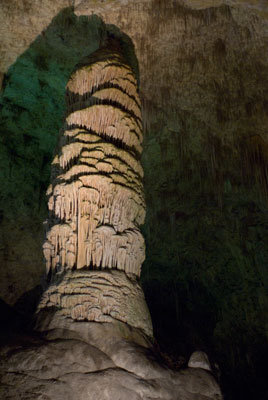
Post cards and ads for the cavern feature photos of the monolithic stalactites and stalagmites for which Carlsbad is famous.  They are impressive but the beauty and diversity of their smaller counterparts were of more interest to Chris’ camera eye.  Illuminated alcoves revealed hundreds of delicate soda straws in pale white and tawny tones reaching for the floor.  Some surfaces were covered by brown popcorn, a feature completely new to the visitors, while the gentle folds of draperies adorned others.  All of this beauty created over the millennium through the simplicity of dripping water.


An iconic stalagmite in the Big Room.


Popcorn.


The first day of their visit Chris had camera in hand but the dim light required such long exposures that it was declared a “scouting day” and she took snapshots of features she wanted to focus on during their return trip.  They wasted the remainder of the day driving a nine-mile loop road that snaked along the ridge of the mountain, then descended into a valley and finally emptied onto the Park’s main road.


A mountain along the Park road.


The distant Guadeloupe Mountains seemed surprisingly high for Chris and Jay’s perception of what the desert southwest contained, but they were rapidly learning the realities of the area as the day had dawned blowing gale force winds with 60 mph gusts.  The twisting and rutted gravel road slowed their progress to that of a snail, but from the warm security of Big Red’s cab they bounced along enjoying the mountain vistas and chatting about the force of water required to sweep the volume of softball sized rocks and small trees into the piles of rubble they found along the dry stream bed in the valley.  They were still not sure that they would call the terrain “beautiful” as the spiny clumps of prickly pear cactus, yucca, sotol and small green shrubs scattered amongst the brown grass was completely foreign to the towering oaks they left behind in Maryland.  But its rugged contrast had a certain appeal they could not quite put their fingers on.

The next day they decided to enter the cavern via the natural entrance - a hole in the ground over 50’ wide dropping into an inky abyss hundreds of feet below.  Their reasoning that they would enjoy seeing the area’s offerings while walking downhill in a fresh and rested state rather than attempting to ascent the steep path, huffing and puffing and concentrating on how bad they felt at the end of a long day.  They patted themselves on the back for such good headwork as the path zigzagged sharply down the sheer, vertical face of the entrance for hundreds of feet, then leveled out a bit before plunging down another wall, repeating the same several times throughout the descent.  Remember the floor of the Big Room is over 700’ down and they easily walked ten times that distance on the switchbacks.  The mile and a half long section of the cavern was plain in comparison to the decorative main chamber, but the ceiling, hundreds of feet above their heads, impressed upon the travelers how miniscule they are compared to nature’s grandeur.


The first few switchbacks at the natural entrance.


By closing time Chris had filled the camera’s memory card and happy, but a bit tired, she and Jay were some of the last to enter the elevator for the trip to the top.


Chris’ favorite photo of the day showing an alcove filled with soda straws.


They wished they had at least another day to visit Sitting Bull Falls and hike a trail in the Guadeloupe National Forest but over the past two years of traveling Chris and Jay learned to not pack too much sightseeing into short stays as the writing and posting of the blog and most importantly, the editing of photos, falls behind.  So, the last day of their stay the photos were edited, bills were paid, Red got some badly needed maintenance, and preparations for the next day’s departure to White Sands National Monument were made.

Tuesday, March 1, 2011

Remember The Alamo

Chris and Jay continued their journey through Texas like a stone skipping across a pond as they hopped from Houston to Austin to Wimberley and finally to San Antonio.  They took a chance at not making a reservation and were able to secure a campsite for two days at the Lackland Air Force Base RV Park.  They leaned that Lackland is the Cape May of the Air Force; a boot camp training base.  When they went about their shopping and sightseeing travels through the base, they encountered companies of children – sorry, recruits, marching in formation as they made their way from class to class.

The Alamo was originally built across the river from the town of San Antonio and served as a mission in the 1700s to convert the native Indian population into Christian, Spanish citizens.  Chris and Jay felt very strange driving past high rise office buildings into the heart of downtown San Antonio to find the six acre Alamo shrine.


The famous façade.


Many of the home and commercial buildings in Texas are constructed of a cream colored limestone and the tall stone wall surrounding The Alamo grounds appeared to be made of the same material, only weathered, aged and mottled with darker hues.  They learned that the church, known for its infamous, round-topped front facade, was only a small part of the compound where the battle for Texas liberty was waged.


A portion of the stone wall surrounding The Alamo grounds.


When the structure was abandoned by the church in the 1790s the Spanish Army moved in and built a huge drilling compound surrounded by a protective stone wall.  It is in this enclosure that the 189 brave men gave their lives to protect Texas from the self-proclaimed dictator, General Antonio López de Santa Anna. 


A 3 dimensional sculpture depicting the entire grounds
of The Alamo at the time of the battle.
The chapel is at the upper right hand corner.


Some were born in town but most migrated from almost every state in the Union at the time.  European immigrants from Ireland, Germany, England and Scotland joined them, coming months and years earlier to start a new life and buy land for a mere 12.5 cents per acre; a price the Spanish government had used to entice settlement of the Texas territory in the early 1800s prior to the Mexican independence war.  Among them were two famous frontiersmen – James Bowie and David Crockett.  Bowie had married a local girl and, as was the custom, they lived in her parent’s home in town.  Crockett had been a member of the Tennessee legislature but left the State for Texas when he became dissatisfied with their politics.


Flags representing the states and countries from which the volunteers
came stand around the perimeter of the church interior.


General Santa Anna, Mexico’s elected leader, decided to change the governing structure from one modeling the United States, of individual States, to a centralist government with all power emanating from Mexico City – meaning Santa Anna.  (Sound familiar?)

Taxes and other restrictions were imposed and over time the Tejanos decided they wanted to become an independent territory.  They seized The Alamo and other military encampments racking up some early victories.  But the 189 volunteers were not enough to defend The Alamo against over 2,200 of Santa Anna’s men.

Beginning on February 23, 1836, the Mexicans bombarded the compound with cannon fire for 13 days.  Then, before dawn on March 6th the Tejanos fended of two charges before succumbing to the third.  The volunteers took over 600 Mexican soldiers with them in their struggle.

Their deaths were vanquished several weeks later when General Sam Houston defeated Santa Anna at the Battle of San Jacinto near present day Houston.  A treaty was signed and Texas became TEXAS thus proving the saying “Don’t Mess With Texas!”

The San Antonio River runs through the city of the same name and along its banks is the “River Walk” a menagerie of restaurants and shops that border a broad, paved walkway immediately adjacent to the water.  In fact if one was distracted from their intended path, one could easily fall in!  Next to the Alamo, it is THE attraction in town as it meanders five miles in an immense horseshoe.


A stairway leading from the street level to the River Walk.


Chris and Jay took a mid-day break and dined at The Rainforest Café; a restaurant Chris had always heard about but had never patroned in the D.C./Baltimore area.  The interior was elaborately decorated with faux stone walls, whose surfaces and ceilings were covered with artificial flowers, vines and greenery.  Life-sized chimpanzees and a tiger nestled amongst the foliage near them periodically came alive as they moved, chattered and roared during the meal.  The food was surprisingly good and thus fortified, Chris and Jay continued their exploration of the city and planned their departure to Fort Stockton the next day.